


Renovation vs. Rebranding in 2026: When a Brand Change Delivers Better Hotel ROI
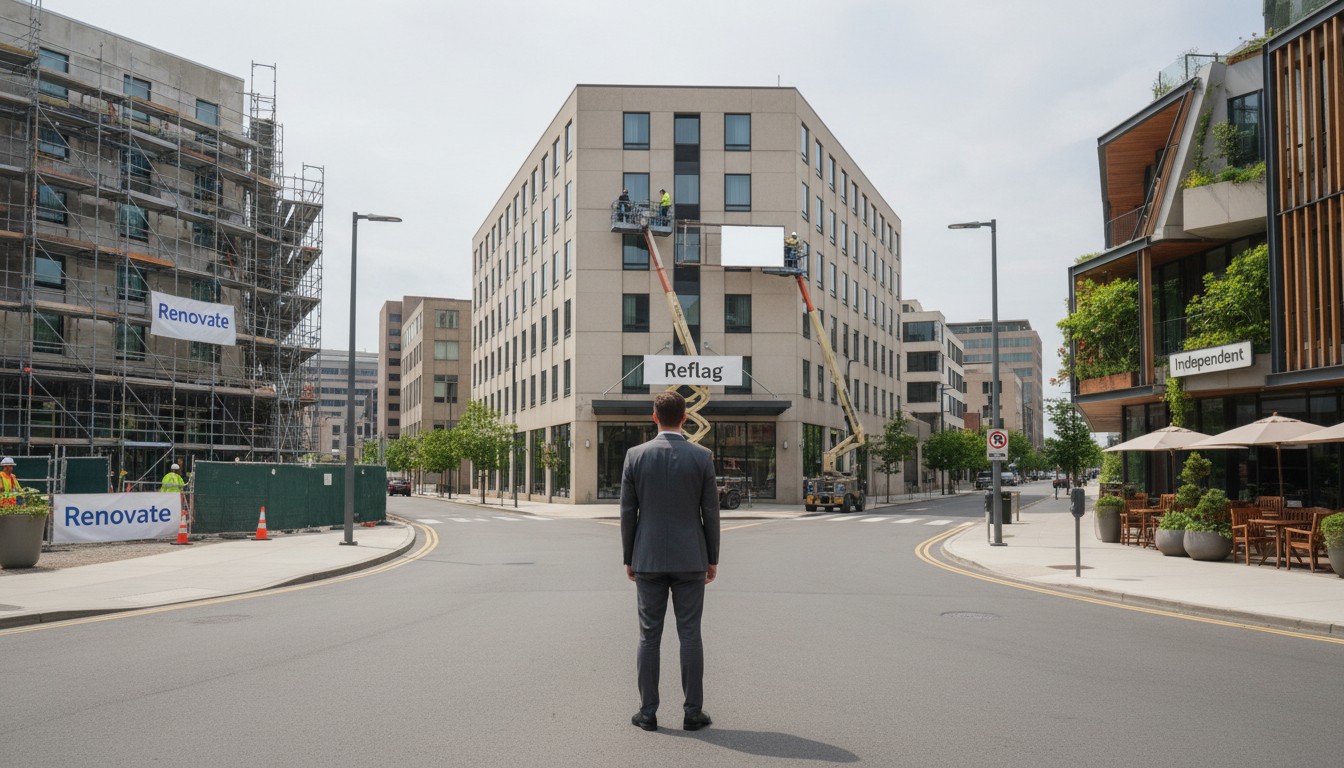
For hotel owners across the U.S., one question keeps coming up in 2026: should you invest in renovation or rethink your brand entirely?
With tightening margins, stricter PIPs, and shifting guest expectations, this is no longer just a design decision. It's a capital allocation strategy that directly impacts asset value, NOI, and long-term positioning.
Owners today are choosing between three paths: stay with the current brand and renovate, reflag to a new brand, or move to a soft brand or independent model. Each can work, but only if the numbers and positioning align.
Why This Decision Is More Urgent in 2026
The U.S. hotel market is undergoing a challenging reset. In 2025, national occupancy slipped to about 62–63% (According to CoStar data reported by Hotel Management Magazine) and RevPAR declined to roughly $100, marking the first year-over-year drop since 2020. ADR edged up slightly, but margins tightened as costs continued to rise.
Looking ahead, CoStar and Tourism Economics forecast RevPAR growth of only around 0.6% for 2026, driven by a modest 1% ADR lift and a small dip in occupancy. Performance gains are expected mainly among upper-upscale and luxury properties in key urban markets, while midscale and leisure-focused hotels face ongoing headwinds.
Development activity is shifting from new builds toward asset repositioning and brand conversions, now at record levels-nearly 1,500 projects in the pipeline at the end of Q4 2025, up about 12% year over year. Owners’ attention has clearly moved from “whether to renovate” to "how to maximize returns."
Option 1: Stay with Your Brand and Renovate
When it makes sense
Staying with your current flag is often the most defensible path when your brand still aligns with your market, the property is performing reasonably well, and brand-driven demand remains a meaningful revenue driver.
What you gain
Continued access to brand reservation systems, marketing infrastructure, and operational standards. In uncertain markets, branded distribution can stabilize occupancy.
What you give up
Limited flexibility in design and operations, mandatory PIP compliance, and ongoing franchise fees. Typical brand costs include royalty fees of 2–6% and marketing/reservation contributions of 1–4% of revenue. Over a 10-year hold, these fees compound significantly against net operating income.
ROI reality
Renovation under an existing flag delivers ROI when the brand premium outweighs total franchise cost. If the brand is underdelivering on that equation, renovation alone won't close the gap.
Option 2: Reflagging — Switch to a Better-Aligned Brand
Reflagging is one of the fastest-growing strategies in the U.S. market, and for good reason. It can deliver the impact of repositioning without the complexity and cost risk of going independent.
When it makes sense
When your current brand is misaligned with local demand, when PIP requirements feel disproportionate to the expected return, or when there's a clear opportunity to move into a stronger market segment - midscale to upscale, for example.
What you gain
Access to a stronger distribution platform and brand perception, potential ADR lift through repositioning, and a more competitive profile against your compset. Investors frequently use reflagging as a value-add strategy in acquisitions of underperforming assets.
What you risk
New PIP requirements from the incoming brand, transition costs (branding, systems, staff training), and a temporary disruption in bookings during changeover.
ROI reality
Reflagging tends to outperform simple renovation when the existing brand is failing to generate demand that justifies its cost. The upside often comes not from the physical renovation itself, but from changing how the asset is perceived and distributed in the market.
Option 3: Soft Brand or Independent
This is the most strategically complex option and, in the right circumstances, the most rewarding.
When it makes sense
When your property has genuine distinctiveness - location, design, story, that a major brand would dilute rather than amplify. Or when franchise fees have grown to the point where brand-driven revenue no longer justifies the cost.
What you gain
Full control over pricing, design, and operations. No royalty fees. The ability to build a direct relationship with guests and differentiate meaningfully in competitive markets. The independent and soft-brand segment is growing, particularly in lifestyle and boutique positioning.
What you lose
Brand-driven demand: loyalty program bookings, centralized marketing, and the credibility that comes with a recognized flag, particularly important in secondary markets where travelers rely on brands for quality assurance. Expect a revenue transition period if distribution is not carefully planned before departure.
ROI reality
Independence delivers stronger long-term returns when the property already generates strong direct or repeat demand, when franchise fees exceed the value of brand-sourced revenue, and when the operator has genuine revenue management capability. Without those conditions, the risk is real.
How Smart Owners Are Deciding in 2026
The most effective approach is to evaluate all three through a disciplined ROI lens. Four questions drive that analysis:
- Is the current brand generating measurable value - ADR premium, occupancy lift, distribution advantage,that exceeds its total cost?
- What is the true cost of PIP compliance, and does it scale proportionally to the asset's potential value?
- Does repositioning unlock a different market position - a new guest profile, higher pricing power, or a less competitive segment?
- Does the team have the revenue management and marketing capability to succeed without brand infrastructure?
The answers look different for every asset. But in 2026, owners who treat this as a purely operational question are leaving value on the table. This is a capital strategy decision.
The Bottom Line
In today's market, the owner needs to see whether the current brand strategy is maximizing the value of the asset you own.
If it is - renovate and stay. If it isn't - reflag or reposition. If brand fees are eroding the returns - consider independence.
The highest ROI in 2026 comes from aligning brand, design, and operations as a single strategy, not treating them as separate decisions made at different times.
Evaluating your options? At Liberty Way Renovation, we work with hotel owners across the U.S. from PIP cost analysis to full brand renovation.