


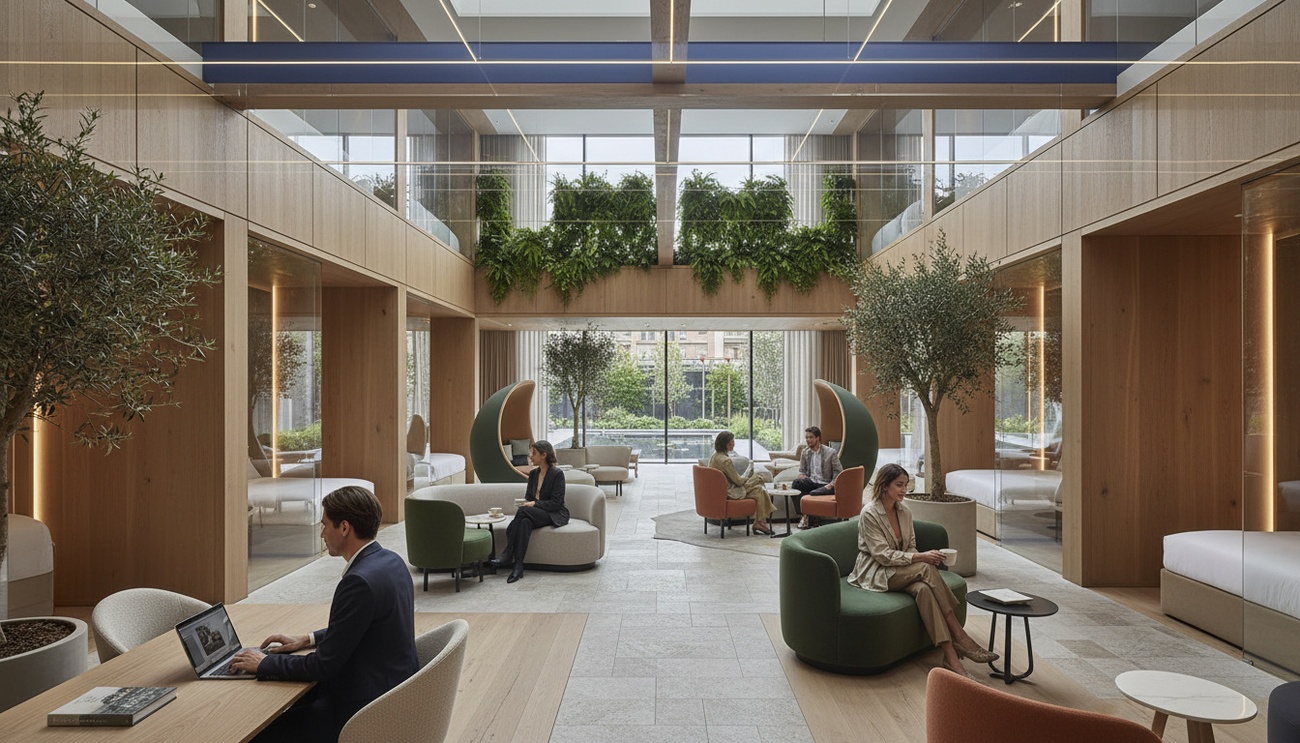
As 2026 unfolds, the U.S. hotel industry is operating in a complex environment shaped by higher capital costs, changing demand patterns, and evolving guest expectations. For hotel owners planning renovations, understanding these broader forces is essential for making informed decisions about budget, timing, and design that protect asset value and support long-term growth.
Below is an overview of the most important 2026 trends, supported by current industry commentary and market data, along with what they mean for your renovation strategy.
1. Renovation and Adaptive Reuse as Strategic Growth Levers
Renovations and conversions now represent a growing share of hotel investment activity, often offering a faster, less capital-intensive path to growth than ground-up construction. Elevated financing costs, construction inflation, and labor constraints have made new builds more challenging, prompting many owners to focus on upgrading and repositioning existing properties instead of adding large volumes of new supply.
At the same time, a significant share of recent adaptive reuse projects in the U.S. have involved hotel properties, with hotel conversions in some markets outpacing office-to-residential conversions as investors seek flexible, income-producing assets. This trend includes both full conversions and partial repositioning into mixed-use formats that blend hospitality, residential, and commercial functions.
What this means for renovation planning:
- Expect more competitive renovation markets where repositioning existing inventory can unlock value more quickly than pursuing new construction.
- Assess opportunities for adaptive reuse of underperforming assets or combining renovation with partial conversion./li>
For a deeper look at how renovations directly affect asset performance, see our article: Why Renovating Now Pays Off Later: Hotel Owners' Guide to ROI
2. Market Outlook: Slow Growth, Selective Opportunity
Industry outlooks for 2026 generally point to low single-digit RevPAR growth and a gradual stabilization of occupancy and ADR rather than a return to the rapid post-pandemic rebound. Leisure demand remains relatively resilient, particularly in secondary, resort, and drive-to markets, while corporate and group travel continue to recover at a measured pace across key urban destinations.
This environment rewards owners who align renovation timing and scope with specific demand segments and submarkets rather than assuming broad-based performance gains. Upper-midscale, lifestyle, and luxury properties that differentiate through design, experience, and service are often better positioned to capture incremental revenue even in slower growth conditions.
Implications for renovation decisions:
- Time major projects to capture expected demand improvements in the back half of 2026 and beyond, while minimizing out-of-order inventory during softer shoulder periods.
- Prioritize investments that strengthen guest experience, loyalty, and rate resilience.
If timing and phasing are critical to protecting cash flow during construction, our timeline breakdown may help: Hotel Renovation Timelines in the USA: What Hotel Owners Should Know
3. AI, Data, and Technology-Ready Renovations
AI-driven tools are rapidly reshaping hospitality, with operators using them for revenue management, demand forecasting, personalization, and operational efficiency. As more guest touchpoints become data-enabled, from mobile check-in to in-room controls and tailored offers, the underlying building infrastructure becomes strategically important during renovations.
Rather than treating technology as an add-on, leading owners now design renovations to support scalable, flexible digital ecosystems that can evolve over the asset's life.
For renovation planning, this translates to:
- Integrating robust low-voltage, network, and IoT infrastructure during construction to support AI-enabled services such as personalized in-room experiences, dynamic lighting, guest profiling, and energy optimization.
- Incorporating strategic data collection points and ensuring that wiring, backbone, and hardware locations are designed with future upgrades and integrations in mind.
4. Bleisure, Remote Work, and Flexible Space Design
Bleisure and work-leisure travel, where business trips merge with leisure stays and remote work, have become mainstream drivers of hotel demand, particularly among younger and higher-spend traveler segments. Guests increasingly expect rooms and public areas to support both productivity and relaxation, with reliable connectivity, quiet zones, and comfortable work settings as standard rather than optional features.
As a result, hotels are rethinking how guest rooms, lobbies, and meeting spaces are configured, shifting from strictly formal business areas to flexible social-work hubs that can adapt throughout the day. This trend aligns with the growth of extended-stay and lifestyle concepts that emphasize multi-functional spaces and longer average length of stay.
Design implications for 2026 renovations:
- Plan adaptable room layouts with clearly defined work zones, ergonomic furniture, and integrated power/USB points, while maintaining a calm environment suitable for sleep and relaxation.
- Upgrade lobbies, lounges, and F&B spaces to function as social/work hubs with varied seating and technology that supports informal meetings and remote work.
- Create flexible meeting and event areas that can serve local businesses, co-working needs, and small groups without disrupting core guest experiences.
5. Sustainability and Wellness as Baseline Expectations
Sustainability has moved from "nice-to-have" to a core expectation for guests, corporate travel buyers, and capital providers, particularly within ESG-focused investment strategies. Energy efficiency, water conservation, and responsible material choices now directly influence not only operating costs but also brand positioning, RFP competitiveness, and asset valuations.
In parallel, wellness is being integrated into everyday guest experience rather than remaining confined to spa areas, with growing emphasis on sleep quality, air and light, and opportunities for movement and mindfulness.
Owners planning renovations should focus on:
- Eco-efficient systems such as smart sensors for lighting and HVAC, low-flow fixtures, improved envelope performance, and building management systems that reduce utility loads over the asset's life.
- Responsible finishes and materials that support both ESG narratives and guest comfort.
- Wellness-oriented features including sleep-focused rooms, enhanced air quality and filtration, biophilic elements, and dedicated spaces for fitness or mindfulness.
6. Conversions, Mixed-Use, and Repositioning Momentum
A growing number of projects involve converting hotel assets into residential, serviced apartment, or broader mixed-use schemes as investors seek diversified income streams and resilience. Across major U.S. markets, hotel conversions and hybrid hospitality-residential concepts have added thousands of new units in recent years and remain a notable component of adaptive reuse pipelines.
For owners, this means that renovation scope increasingly intersects with strategic repositioning, even if a full conversion is not immediately planned. Designing with flexibility in mind can preserve optionality for future mixed-use or extended-stay components without requiring a complete redesign down the line.
Strategic insights for renovation scope:
- Upgrade amenity spaces (gyms, lounges, co-working) so they can serve both traditional hotel guests and potential long-stay residents or local community users.
- Design service and back-of-house areas with enough flexibility to support different operating models, including leasing or branded residential components.
7. Renovation vs. New Supply: A Shifting Balance
While the overall U.S. hotel development pipeline remains sizable, the volume of rooms actively under construction has declined in recent periods, reflecting caution amid higher costs and tighter lending conditions. Many owners are choosing to defer or scale back ground-up projects, redirecting capital toward renovations, brand repositioning, and asset-light growth strategies.
This shift elevates renovation from a periodic maintenance exercise to a core strategic lever in portfolio management and value creation.
For 2026 renovation planning, owners should:
- Rigorously evaluate the performance and potential of existing assets before committing to new construction, especially in markets with muted demand growth or supply overhangs.
- Model whether renovation, repositioning, or partial conversion offers a faster and more risk-adjusted path to improved NOI and asset value.
- Use renovation to modernize product, align with brand standards, and enhance investor appeal through clear ESG, technology, and experience narratives.
Renovation in 2026: A Strategic Imperative
Going into 2026, hotel renovation is no longer just about refreshing finishes, it is a strategic response to economic realities, evolving guest behavior, technology shifts, and investor expectations. From adaptive reuse and mixed-use concepts to AI-ready infrastructure, sustainability, and wellness-oriented design, owners who treat renovation as a long-term strategic tool are better positioned to protect and grow asset value.
Aligning your next project with these broader forces, rather than approaching renovation as isolated capex, will be a key factor in how your property competes, performs, and attracts capital over the rest of the decade.
Ready to Plan Your 2026 Renovation with Confidence?
Liberty Way Renovation helps hotel owners navigate complex renovation landscapes with phased execution, brand-compliant design, and future-ready solutions tailored to U.S. hospitality assets. The team focuses on minimizing out-of-order inventory, coordinating with brand and operations, and integrating sustainability and technology elements that support both current performance and long-term asset strategy.
Call +1 229 444-9535