


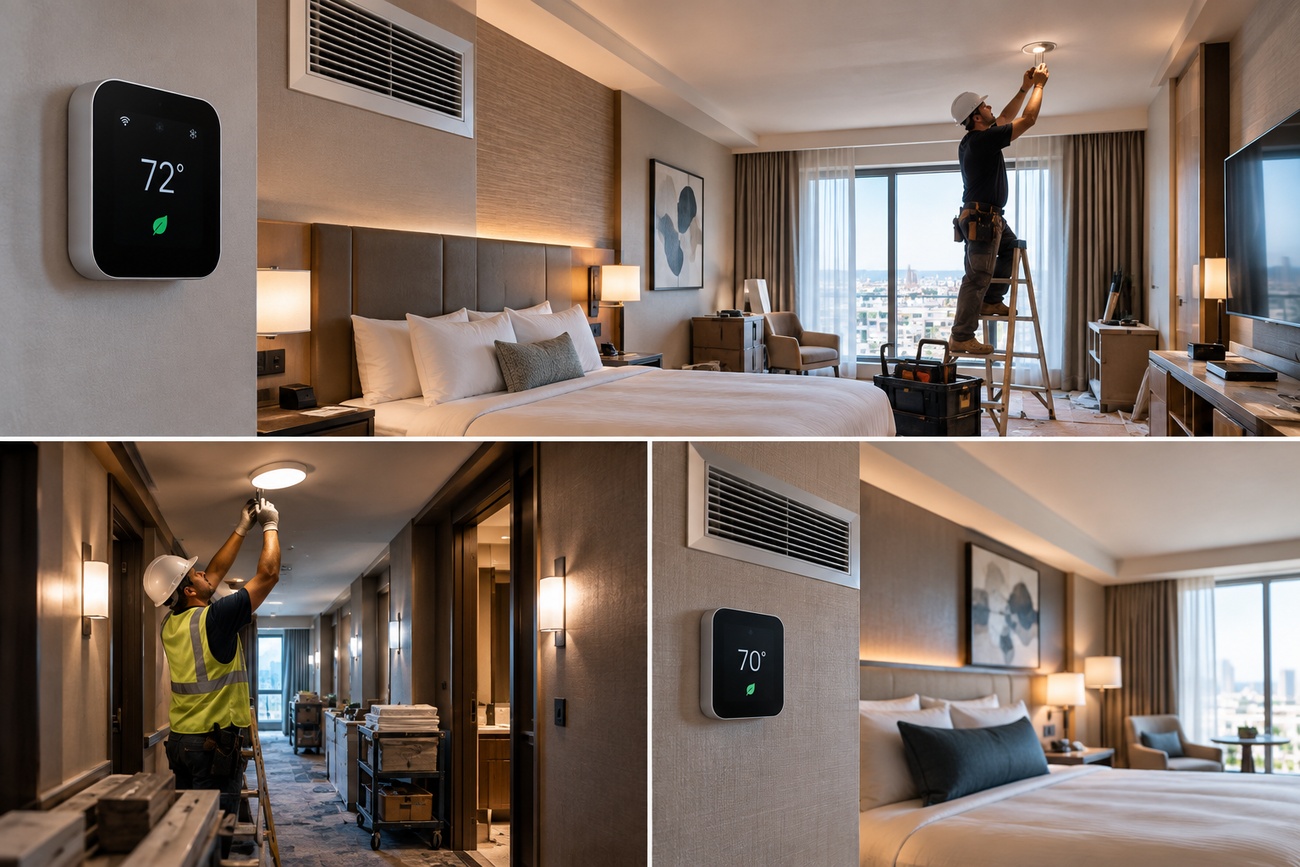
Energy-Efficient Hotel Renovations: What Actually Pays for Itself in 2026
Every renovation RFP that crosses a hotel owner's desk these days seems to come with a sustainability add-on attached. Solar carports, greywater recycling, low-flow everything, building-wide smart sensors. Some of it earns its keep inside the renovation budget. Most of it does not, at least not on the timeline that matters to an owner who needs the project to cash flow within a few years, not a few decades.
The upgrades that actually move the needle are narrower than most sustainability pitch decks suggest, and the financial case for them shifted in a real way in 2026. The federal Section 179D tax deduction for energy-efficient commercial buildings is no longer available for projects whose construction begins after June 30, 2026. Projects that began construction on or before that date may still qualify, subject to the applicable requirements.
Utility data now sits at the center of brand PIP conversations. And the guest research on “green” hotels is murkier than the marketing around it makes it sound. Here's what the numbers actually support, and where they came from.
Start with the ENERGY STAR Score, Not the Equipment List
Before signing off on any efficiency scope, benchmark the property in EPA's ENERGY STAR Portfolio Manager. It compares a hotel's energy performance against similar properties nationwide, adjusted for weather and operating characteristics, and returns a score from 1 to 100, where 50 represents median performance and 75 or higher means the property may be eligible for ENERGY STAR certification. National ENERGY STAR datasets are based on historical benchmarking data, so they should be treated as a market benchmark rather than a substitute for the property's own current utility data.
Benchmarking before scoping tells you whether the property's real problem is the envelope, the HVAC plant, the lighting, or just how the building is operated day to day. Skipping this step is why some renovations fix the wrong system first. A guestroom lighting retrofit photographs well for a case study, but if a rooftop unit installed when the property opened is doing most of the damage to the utility bill, new light fixtures alone won't move the ENERGY STAR score much. Pull twelve months of utility data before the design team finalizes scope, not after.
The Lighting Retrofit Is the Easy Yes
Replacing incandescent and older fluorescent fixtures with LEDs can cut lighting energy consumption substantially in back-of-house areas like kitchens and offices. Guestroom and corridor lighting sees comparable gains, since LEDs use significantly less energy than incandescent bulbs and last substantially longer, which also cuts the maintenance labor tied to bulb replacement across a property with hundreds of fixtures.
Scale shows the mechanism clearly, even if most independent hotels aren't operating at this size.
In DOE Better Buildings case studies, large hospitality and commercial properties have achieved significant energy savings through lighting retrofits. Lighting vendors commonly quote relatively short payback periods for full-property LED retrofits, but that number moves a lot with local utility rates, existing fixture efficiency, installation costs, and available rebates. I'd treat any vendor's payback promise as a starting point for negotiation, not a guarantee, until you've run the numbers for your specific property and market.
HVAC and Controls Carry the Bigger Number, and the Bigger Disruption
DOE's Better Buildings Hospitality case studies show that energy and water savings can vary substantially depending on the property, existing building systems, and the measures implemented.
HVAC work is also the upgrade owners most often push into a later phase, because unlike a lighting swap it usually means displacing guests floor by floor or shutting a wing down entirely.
That's a legitimate scheduling problem. But PIP cycles and brand-mandated system replacements have a way of forcing the issue eventually, and folding HVAC and controls into the same construction mobilization as a broader room renovation, rather than treating it as a separate future project, tends to save money on general conditions and guest disruption alike. We've covered how to sequence work like this without shutting a property down in our guide to Hotel Renovation Timelines in the USA.
What the Savings Are Actually Worth in ADR Terms
ENERGY STAR frames efficiency gains in revenue terms that are easier to weigh against renovation cost in a capital planning conversation: a 10 percent reduction in a hotel's energy use has been compared with the financial impact of approximately a $0.62 increase in ADR for a limited-service property and a $1.35 increase in ADR for a full-service property.
That comparison is worth bringing into an owner or asset manager meeting, because an ADR increase is hard to manufacture in a competitive submarket, while a utility bill is a cost the operator can control directly through the systems installed during renovation. The figures should be treated as a financial comparison rather than a prediction that a hotel can simply raise its ADR by those amounts.
The Financing Landscape Shifted in 2026, Know It Before the Next Project
The federal Section 179D deduction previously allowed qualifying commercial building owners and other eligible taxpayers to claim a deduction for certain energy-efficient improvements to lighting, HVAC and hot water systems, and the building envelope. The 2025 federal tax legislation changed the rules. For projects beginning after June 30, 2026, the federal §179D deduction is generally no longer available, subject to applicable transition rules.
That date matters for owners planning efficiency work now. Any renovation budget that assumes §179D will offset an upcoming project should be reviewed with a qualified tax advisor before the project scope is finalized.
That doesn't mean the incentive landscape is empty. Utility rebate programs, state and local efficiency incentives, and Property Assessed Clean Energy financing in states that authorize it for commercial buildings may still be available. These programs vary by location, utility territory, technology, and project eligibility.
The Database of State Incentives for Renewables & Efficiency (DSIRE) is a useful starting point for identifying available programs. Checking DSIRE and the property's local utility incentives before finalizing an efficiency scope is worth the time it takes. Rebate stacking can change which upgrades actually pay back inside the renovation timeline, sometimes moving an HVAC upgrade from a “phase two” item to something worth pulling into the current project. It's also worth reading up on where energy efficiency fits among the broader trends shaping renovation scopes this year in our piece on Hotel Design Trends in the U.S. to Watch in 2026.
The Guest Revenue Case Is Real, but Don't Oversell It
Sustainability can influence guest choice, but the willingness-to-pay premium varies significantly by traveler segment, market, property type, and how credible the hotel's environmental claims are. Owners should therefore be cautious about building a renovation pro forma around a presumed “green premium.”
The more actionable point is that guests increasingly discount vague “eco-friendly” messaging and respond better to specific, verifiable claims: an ENERGY STAR certification, a documented LED retrofit, measurable energy reductions, or clearly communicated water-saving initiatives. If a renovation includes efficiency upgrades, that's a reason to say so specifically in guest-facing marketing rather than reaching for softer language.
For most owners, however, the stronger business case remains operational savings first, with guest-facing sustainability benefits treated as additional upside rather than the primary justification for capital spending.
What Actually Pays Back Fastest?
For most U.S. hotel owners, the strongest near-term payback opportunities are relatively straightforward.
LED lighting and basic controls are generally among the fastest and easiest efficiency improvements to justify. Installation can often be incorporated into an existing renovation with limited disruption, particularly when fixtures, ceilings, or electrical systems are already being replaced.
HVAC optimization and controls can produce a larger financial impact, particularly in older properties with inefficient equipment or poor operating controls, although the investment and installation complexity are higher.
HVAC equipment replacement can also make strong financial sense when existing equipment is approaching the end of its useful life, particularly when the work can be combined with broader renovation mobilization and the cost of a separate future project can be avoided.
Other investments are more property-specific. EV charging, solar, greywater systems, and major building-envelope upgrades can be worthwhile, but their economics depend heavily on utility rates, incentives, building characteristics, available space, local regulations, and expected utilization.
The practical priority for most owners is therefore to start with measures that combine shorter payback, limited guest disruption, and low installation complexity, then evaluate larger capital investments against the property's actual utility data and available incentives.
The right question is not which sustainable technology is most advanced. It is which efficiency investment produces the strongest risk-adjusted return for this property?
Sequencing the Scope
Efficiency work earns its place in a hotel renovation budget when it's sequenced deliberately. Benchmark first, so the scope targets the system actually driving the utility bill. Fix lighting early, since it's usually one of the fastest payback opportunities in the plan. Fold HVAC and controls into the same construction mobilization as the broader renovation instead of deferring them to a future phase that may never get funded. And check what's actually still available in rebates and financing before assuming last year's tax picture still applies, because in 2026 it doesn't.
Liberty Way Renovation builds efficiency scopes into hotel renovation projects across the USA as part of the base construction plan, not as a bolt-on line item. If you're planning a hotel renovation that includes lighting, HVAC, controls, or other efficiency upgrades, contact us to discuss how that work can be integrated into the renovation scope, phasing, and construction schedule.