


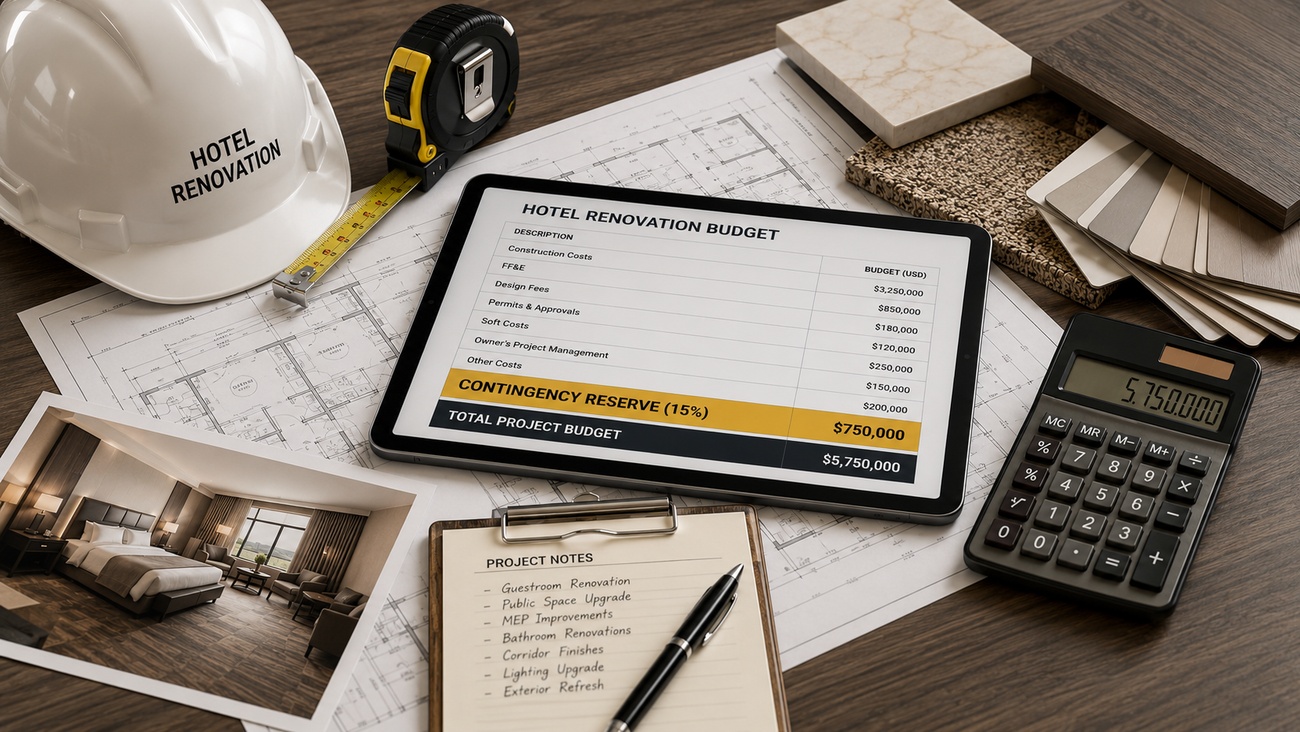
Hotel renovation budgets get built carefully: contractor bids, material quotes, design fees, FF&E estimates, permit costs, and operating assumptions. Then construction starts, and the number begins to move. A wall comes down and there is water damage behind it. The brand updates its specifications mid-project. Imported materials arrive with unexpected pricing increases. A subcontractor falls behind schedule and creates labor overruns across multiple trades. None of this is unusual in hotel renovation. On older hotel assets especially, contingency rarely stays untouched.
Most owners know they need a contingency reserve. The harder question is how much contingency a hotel renovation actually needs and how to structure it so the reserve protects the project instead of quietly disappearing into avoidable scope creep. A contingency that is too small runs out before the project closes. A contingency with no governance around it often gets consumed by changes that should have been resolved during design.
Getting this right is one of the most important financial decisions in any hotel renovation project, particularly in a market where construction costs, brand standards, and procurement timelines remain volatile in 2026.
Why Hotel Renovation Budgets Almost Always Run Over
Construction is difficult to estimate precisely even under ideal conditions, and hotel renovation adds several layers of complexity on top of standard commercial work.
Existing buildings conceal conditions that only become visible once demolition starts. Pre-1990 properties carry a particularly high likelihood of surprises: asbestos-containing materials in floor tiles and pipe insulation, outdated electrical systems wired below current code, undocumented plumbing modifications, and structural conditions that were patched rather than fully repaired decades ago. Any one of these discoveries can materially shift a renovation budget.
Brand standards create a second layer of uncertainty. A Property Improvement Plan approved in January can receive specification updates by spring. PIP documents from major hotel brands function as evolving standards rather than fixed documents, and owners who lock budgets too tightly to early design assumptions sometimes absorb significant mid-project revision costs.
Material pricing remains another moving target. While volatility has moderated compared to the peak disruptions of 2021–2022, procurement pricing across electrical equipment, steel, imported FF&E, lighting packages, and finish materials remains uneven through 2026. Tariff policy and shipping lead times continue to affect renovation budgets across the hospitality sector.
This is why experienced hotel owners rarely view contingency as “extra money.” They treat it as a realistic acknowledgment of how renovation projects actually unfold in the field.
How Much Contingency a Hotel Renovation Actually Needs
The right contingency percentage depends on property age, project scope, and how thoroughly the design is developed before budgeting begins. There is no single number that works across all projects, but there are reasonable ranges that reflect industry practice.
For a mid-scale property doing a standard guestroom refresh where design is complete and the building is relatively modern, a 10 to 12 percent contingency is a workable baseline. For a full guestroom package replacement in a property built before 1990, 15 to 20 percent is more appropriate. Adaptive reuse projects, converting a non-hotel building to hotel use, can require contingency in the 20 to 25 percent range given the structural and systems unknowns involved.
A 10 percent contingency on a $5 million renovation equals $500,000. That may sound substantial until a single unforeseen asbestos abatement issue costs $80,000–$120,000 or more, depending on scope or major plumbing deficiencies are uncovered behind multiple guestroom stacks.
For more on how renovation scope affects budgeting and scheduling, see our articles on Hotel Renovation Timelines in the USA and 2025 Renovation Mistakes Hotels Will Correct in 2026.
Two Types of Contingency, and Why Separating Them Matters
One of the most common budgeting mistakes is combining owner contingency and contractor contingency into a single reserve line. Keeping them separate gives the owner substantially better visibility and control over how money is being spent and why.
Contractor contingency covers the risk the general contractor carries: labor productivity, minor subcontractor pricing shifts, and small adjustments within the defined work scope. This is typically embedded in the contractor's bid, whether or not it is labeled explicitly. It is not money the owner controls directly.
Owner contingency is the reserve the property owner maintains for scope changes they initiate, unforeseen conditions discovered during construction, brand specification revisions, and anything that falls outside the contractor's original scope. This should be held in a separate budget line with clear authorization rules about who can approve a draw and at what dollar threshold. Every draw from owner contingency should be documented with a written explanation of what caused it. At project close, that log becomes a record that informs future renovation planning.
Managing Change Orders Before They Happen
Change orders are the primary mechanism through which hotel renovation budgets erode. Some are unavoidable. Hidden conditions discovered during demolition are part of renovation reality. Owner-driven changes after construction begins are different and are usually preventable.
We see this constantly on hospitality projects where construction starts before finish selections, millwork details, or FF&E specifications are fully finalized. Every unresolved decision carried into construction becomes more expensive later because it now involves rework, labor disruption, schedule impact, administrative processing and procurement acceleration costs.
The most effective way to reduce unnecessary change orders is simple: complete the design before demolition begins.
A formal scope freeze policy also helps significantly. Once contracts are executed, any scope change should move through a structured review process that includes pricing review, schedule impact analysis, written owner approval before work proceeds.
This does not eliminate changes entirely, but it forces visibility into their real cost before they become field directives.
For owners navigating active PIPs, our article How Hotel Brands Are Changing Renovation Approval Processes in 2026 explains why mid-project scope adjustments have become increasingly common.
Structuring the Budget Conversation with Your Contractor
The contingency discussion should happen before construction starts, not after the first budget problem appears. Ask the general contractor to identify the risks they have assumed in the bid and what conditions would trigger a change order. Ask them to separate their own risk reserve from the direct cost line items so you can see what they are carrying.
Owners should also establish a monthly budget review cadence from the start of the project.
Waiting until a renovation is 80 percent complete to reconcile contingency usage is how projects drift into lender issues, emergency capital calls, or rushed value-engineering decisions late in construction.
Early visibility into contingency consumption lets the team make informed decisions about scope, timing, or value engineering before the reserve is exhausted and the options narrow. That flexibility disappears once contingency is exhausted.
Final Thoughts
Hotel renovation contingency planning is not about padding a budget. It is about recognizing how hospitality construction actually works in the field.
Projects involving older assets, active hotel operations, evolving brand standards, and compressed schedules rarely unfold exactly as originally modeled. Owners who acknowledge that reality early usually maintain better control over both budget and decision-making throughout construction.
At Liberty Way Renovation, we help hotel owners across the USA evaluate renovation scope before construction begins, identify hidden contingency risks early, and structure budgets that can absorb real-world project conditions without derailing timelines or operations.
Planning a renovation, conversion, or PIP project? We can help you review scope, evaluate contingency exposure, reduce unnecessary change orders, and build a renovation budget designed to hold up under real operating conditions.