


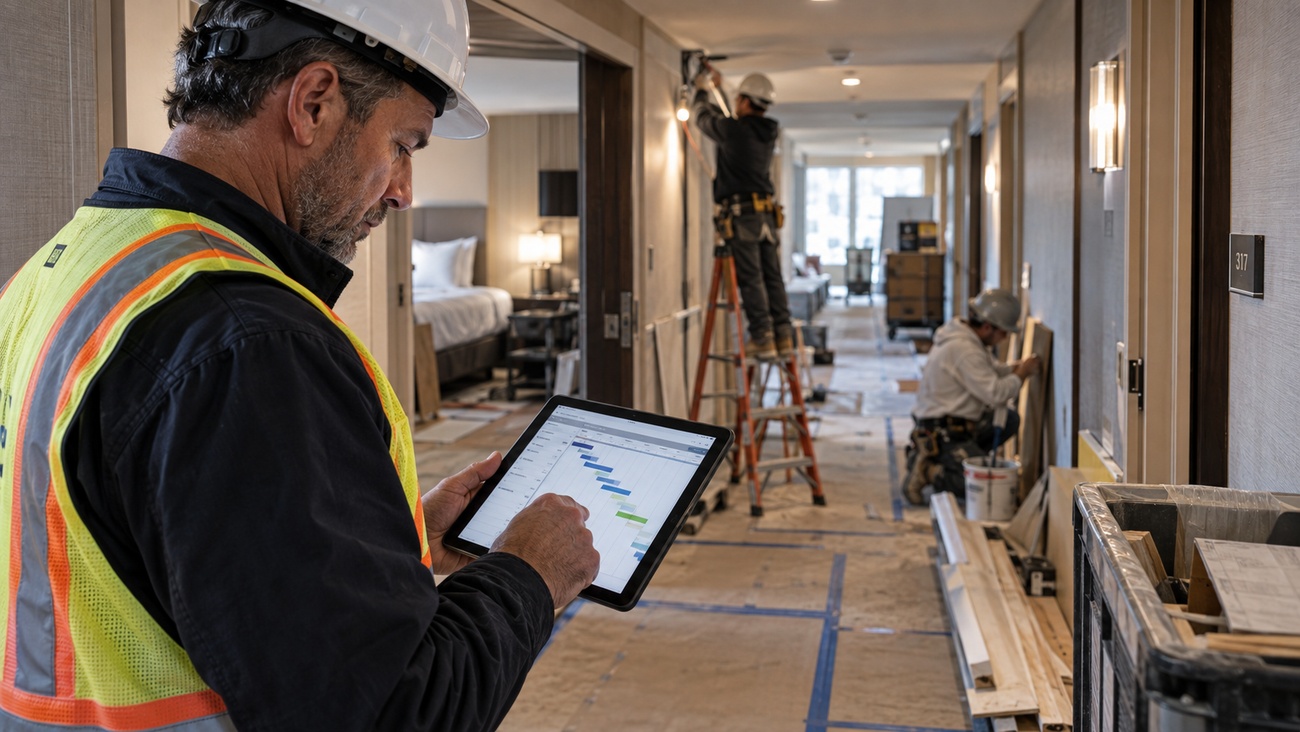
How the Skilled Trades Shortage Is Changing Hotel Renovation Bids and Timelines
A hotel owner sends the same renovation scope to three general contractors and gets back three numbers further apart than they expected, with the schedules stretched longer than the last project three years ago. The instinct is to assume someone is padding their margin. Most of the time that's not what's happening. The gap is coming from the subcontractor market itself, where electricians, plumbers, and finish trades are harder to book and more expensive to hold than they were even two years ago.
This isn't a vague industry complaint. It shows up in bid variance, in schedule float that used to be a buffer and is now a real risk, and in some contractors becoming more selective about the projects and schedules they can realistically staff. Understanding where the numbers actually come from helps an owner tell a realistic bid from a padded one, and plan a renovation that survives contact with the current labor market.
The Numbers Behind the Shortage
Associated Builders and Contractors tracks the gap between construction spending growth and available workers with a proprietary demand model. Its estimate puts the net new workers the industry needs to attract in 2026 at 349,000, rising to 456,000 in 2027 as spending growth is expected to accelerate (Associated Builders and Contractors, 2026). ABC’s January 2026 estimate was substantially lower than the 499,000-worker requirement it had projected for 2026 a year earlier, worth knowing if you see a different total cited elsewhere.
A separate survey brings the picture current. AGC and NCCER surveyed 1,830 construction professionals in July and August 2026 and released results on September 3: 87 percent of firms reported openings for hourly craft workers, and 88 percent of firms with those openings said the positions were as hard or harder to fill than a year earlier. Worker shortages, in a firm's own crews or a subcontractor's, remained the single most-cited cause of project delays, reported by 42 percent of firms.
Why Occupied Hotel Renovation Feels It More Than New Construction
A new-build hotel or a ground-up commercial project can run a full crew on a normal daytime schedule for months at a stretch. A renovation of an operating hotel usually can't. Work has to move around guests, which means noise-sensitive trades get pushed to overnight or off-peak windows, floors get isolated and sequenced instead of opened up all at once, and material deliveries get scheduled around check-in and check-out traffic rather than whenever the truck shows up. That added scheduling complexity narrows the pool of subcontractors willing and able to take the job: not every electrical or plumbing crew wants overnight hotel work when a daytime industrial or data center project is available instead, and in a tight labor market, they have more options.
Timing the project around your property's slower season can ease some of this pressure, since off-peak scheduling gives a GC more room to work around a smaller trade pool.
That last point matters more than it used to, and it isn't spread evenly across the market. In the 2026 AGC/NCCER survey, among the 28 percent of firms that did data center work in the past year, 58 percent reported greater competition for skilled workers and 49 percent reported increased wage pressure as a direct result. Labor demand right now is concentrated around data centers, power infrastructure, and advanced manufacturing rather than tight across every segment, and those projects can pull electricians, pipefitters, and other in-demand trades away from commercial and hospitality work in the same metro area. A hospitality GC competing for crews in a market with active data center construction is competing against that pull, whether or not a hotel renovation looks anything like a data center on paper.
What This Actually Does to a Bid and a Schedule
Three things tend to show up in a bid and schedule, and it's worth knowing which is which when you're reviewing a proposal.
Higher subcontractor pricing. Labor costs show up first in subcontractor pricing: pay for construction production and nonsupervisory workers was up 5.0 percent year over year in August 2026, compared with 3.3 percent for production workers across the private sector, so a GC pricing a job today off last year's subcontractor rates may be carrying a cost assumption that no longer reflects the market when crews mobilize.
More schedule contingency. Schedule float moves second, because a GC that can't get a firm commitment from a specialty sub well ahead of mobilization has to build in more buffer than they used to, and that buffer reads as a longer overall timeline even before anything goes wrong on site.
Wider bid variance. Bid variance moves third: the spread between the low and high bid on the same scope can widen, because different GCs have different depth of direct trade relationships, and a GC with thin subcontractor coverage in your market prices in more risk than one with crews they've worked with for years.
None of this means every high bid is honest and every low bid is a lowball. It means the labor market is now a real variable in how a hotel renovation gets priced, and an owner comparing three numbers should be asking each GC how they're staffing the job, not just what the total says.
How to Protect Your Budget and Your Schedule
Bring your GC into the project during design, not after drawings are finished. A contractor who knows the scope early can start locking in specialty trade commitments, particularly for electricians, plumbers, and fire protection crews, before the schedule is fixed and before those trades book up with other work. Waiting until the design is complete to go out to bid means competing for the same crews everyone else is trying to book for the same construction season.
Ask directly how a bidding GC staffs its projects. A contractor with long-standing direct relationships with a stable roster of subcontractors is a different risk profile than one that re-bids every trade package to the lowest available sub on each job. The first approach tends to hold schedules better in a tight labor market, even if it isn't always the lowest number on paper.
Build real schedule contingency into the plan, especially for phased renovations that require repeated crew mobilization across multiple room blocks or floors. Every remobilization is a point where a crew you had booked might not be available when you need them back, and a renovation plan that assumes 2022-era crew availability is setting up for a preventable delay. For guidance on sizing that buffer, see the article on Hotel Renovation Contingency Planning: How Much Buffer You Actually Need.
Finally, sequence the work to minimize how many times specialty trades have to demobilize and remobilize. A renovation plan that groups electrical, plumbing, and finish work into fewer, larger mobilizations is easier to staff in this market than one that spreads the same scope across many small phases, even if the smaller phases feel gentler on hotel operations in isolation.
The labor market behind a renovation bid isn't something an owner can fix, but it is something a bid should account for honestly. Liberty Way Renovation plans hotel renovation schedules around the trade availability that actually exists in a given market, rather than relying on outdated assumptions about crew availability. If you're planning a hotel renovation, Liberty Way Renovation can help you pressure-test the schedule, trade availability, and cost assumptions before you go out to bid. Contact us to discuss your property and project.