


Most hotel renovation schedules are built around contractor availability, brand Property Improvement Plan (PIP) deadlines, or ownership-level capital cycles. Rarely are they aligned with the property’s actual demand curve. That disconnect is expensive.
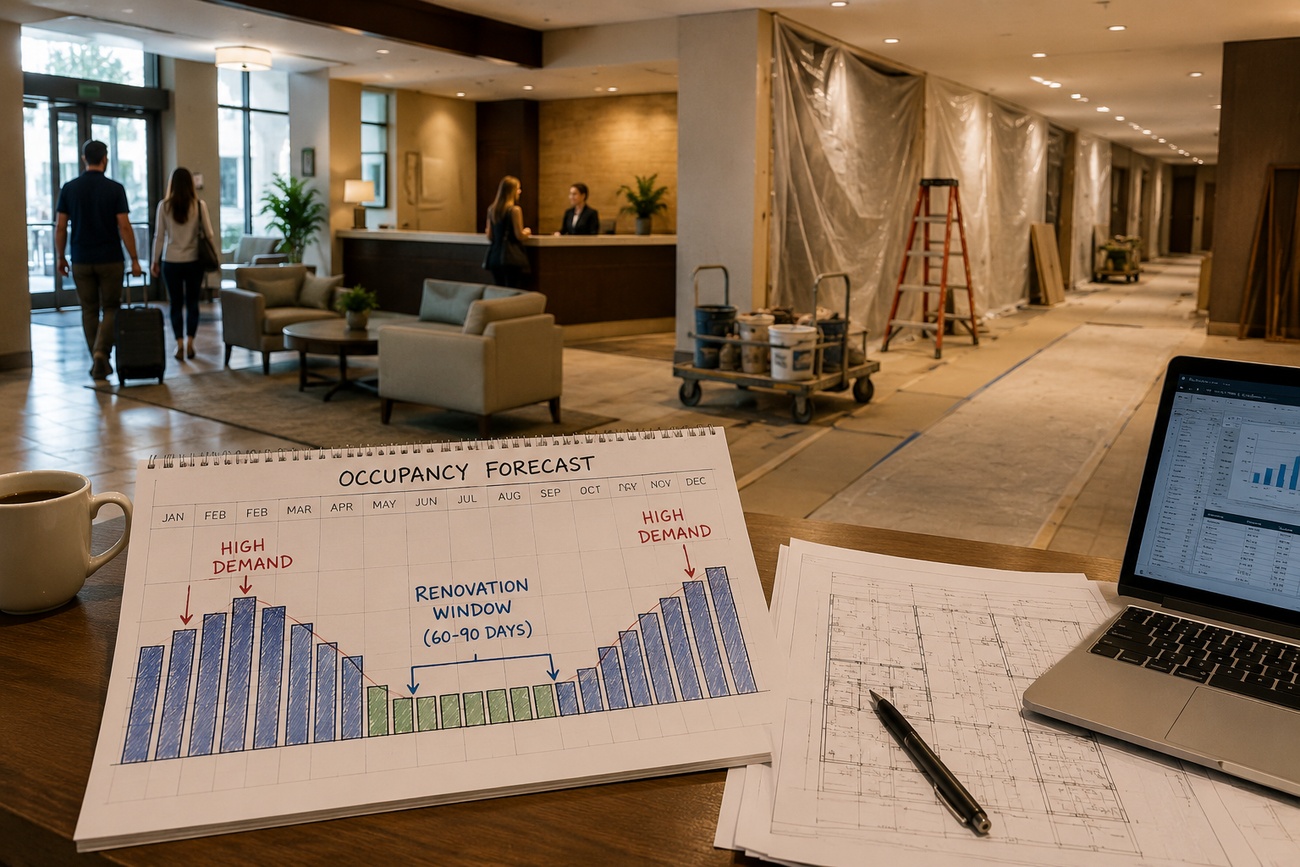
In many mid-scale hotels, shifting a renovation from a peak demand window into a structurally weak 60–90 day period can reduce revenue displacement by 30–60% depending on how wide the property's peak-to-trough demand gap is, without changing construction cost. The difference is not operational, it is purely timing.
The implication is straightforward: renovation ROI is not only a function of scope and budget, but of when inventory is removed from the market.
Revenue Displacement as the Primary Economic Variable
The most accurate way to evaluate renovation timing is through revenue displacement rather than construction cost. Every room taken offline represents lost revenue, calculated through the interaction of available inventory, occupancy levels, and average daily rate over the duration of the outage.
The gap between low-demand and high-demand periods can be significant even within the same property. A renovation executed during a structurally weak booking window can minimize financial impact, while the same project scheduled during peak leisure demand can multiply displacement losses several times over.
The critical misstep many owners make is focusing exclusively on construction pricing and treating timing as secondary. In reality, timing often has an equal or greater impact on total project economics than the bid itself.
Why Market Averages Fail at the Property Level
National or even regional occupancy averages are too broad to be operationally useful for renovation planning. They obscure the actual demand profile of individual assets.
A resort hotel, an urban corporate property, and a highway motel operate on fundamentally different cycles. Resort assets compress outside holiday peaks, urban hotels depend heavily on weekday corporate demand, and leisure-driven markets fluctuate with climate and seasonal travel behavior. Ski destinations invert this entirely, with winter as peak operating season.
This variability makes one point critical: renovation timing must be based on property-specific demand weakness, not industry-wide averages.
In practice, the correct window is usually a 60–90 day period where both occupancy and rate pressure align at their lowest structural point.
For a broader breakdown of how demand cycles translate into execution strategy, see our article on Top 5 Renovation Mistakes Costing Hotel Owners Time & Money.
Identifying the Optimal Renovation Window
Determining the right timing requires a forward and backward view of performance. Historical monthly occupancy and ADR data provide the baseline, ideally across at least three years to smooth out anomalies. This establishes whether demand weakness is structural or event-driven.
That historical view must then be tested against competitive performance data where available, particularly RevPAR Index trends relative to the local comp set. This helps distinguish between market-wide softness and property-specific underperformance, which affects how safely rooms can be taken offline.
Finally, forward-looking demand factors must be layered in. Annual conventions, city-wide festivals, sporting events, and even localized tourism spikes can materially distort what appears to be a low-demand period in historical data.
The correct window is therefore not simply the lowest point in the calendar, but the lowest point that is also operationally stable.
When evaluating how these cycles interact with broader capital planning decisions such as brand requirements or PIPs, it is useful to consider how renovation scope and timing intersect. We explore that dynamic further in Hotel Renovation Contingency Planning: Budget Buffer Guide.
Phasing, Disruption, and the Reality of Operating Hotels
Most hotels cannot afford full closure during renovation, which makes phasing the default execution model. Work is typically structured across floors, wings, or defined zones so that a portion of the inventory remains operational throughout the project.
This approach reduces revenue disruption but extends the overall timeline and introduces operational constraints that affect contractor productivity. Noise restrictions, guest movement, material staging, and access limitations all reduce efficiency compared to a full closure scenario.
For properties subject to brand standards or Property Improvement Plans, phasing is not a strategic choice but a requirement. Completion deadlines impose structure on sequencing, and delays in early phases often cascade into compressed final stages, increasing execution risk.
The trade-off is consistent across projects: lower immediate revenue loss in exchange for longer project duration and higher coordination complexity.
Contractor Availability Is a Binding Constraint
Renovation timing is also constrained by contractor capacity, which is often underestimated in early planning stages. Experienced hotel renovation contractors typically operate on multi-month booking cycles, particularly in competitive markets and peak construction seasons.
As a result, the optimal renovation window identified through demand analysis must be translated into procurement and design timelines well in advance. Planning too late does not reduce cost; it reduces execution quality by limiting contractor selection and compressing mobilization periods.
This is one of the most common disconnects in hotel renovation planning: demand-based timing is identified correctly, but contractor lead times make it operationally unattainable.
Decision Logic: When to Proceed and When to Wait
A renovation should proceed when the identified low-demand window is stable, predictable, and long enough to absorb phased disruption without overlapping meaningful revenue spikes. It should also proceed when external constraints such as brand requirements or financing timelines create a fixed execution horizon that cannot be shifted.
Delaying a renovation is generally justified when the low-demand window is short, volatile, or structurally disrupted by external events that compress availability. In those cases, forcing execution can lead to disproportionate revenue loss relative to the benefit of renovation timing.
Phasing becomes the appropriate strategy when full closure would sacrifice high-demand periods or when occupancy levels remain too strong during the intended renovation window to justify large-scale displacement.
The underlying principle is consistent: renovation timing should minimize revenue sacrifice while preserving execution quality and schedule integrity.
Timing as a Determinant of ROI
Renovation return on investment is not determined solely by cost control or design quality. It is also determined by when the asset is taken offline, how efficiently demand cycles are preserved during execution, and how quickly pricing power is restored post-renovation.
Two properties with identical renovation scopes can produce materially different financial outcomes purely based on timing decisions. This is why timing should be treated as a core component of capital planning rather than an operational afterthought.
What This Means for Hotel Owners
The most effective renovation strategies are built around actual demand behavior rather than administrative or contractual scheduling cycles. Owners who align renovation timing with true low-demand windows consistently preserve more revenue, reduce operational friction, and improve post-renovation pricing power.
Those who do not typically recognize the cost of timing only after displacement has already occurred and revenue has been permanently lost.
At that point, timing is no longer a planning variable, but it is a realized expense.