


What to Upgrade When You Renovate: A Hotel Owner’s Guide to Technology
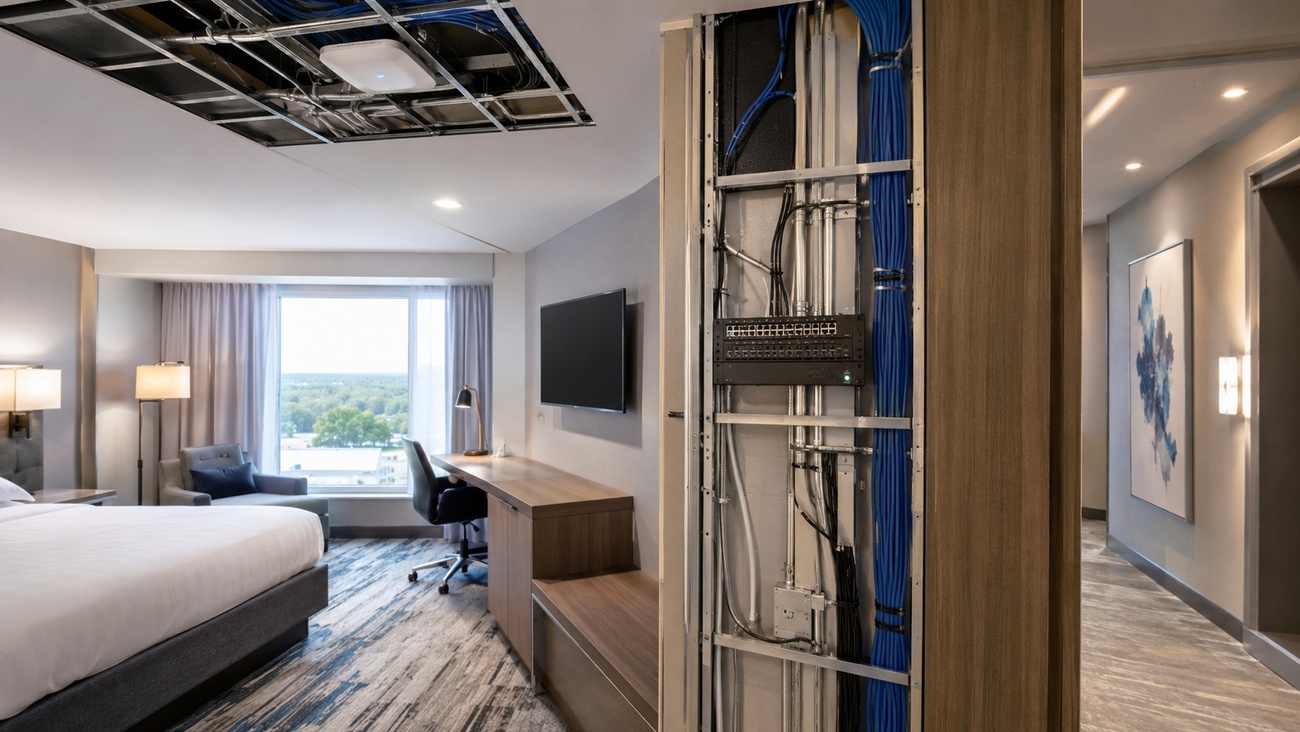
Every hotel renovation is also an infrastructure decision. When the walls are open, ceilings are exposed, and conduit runs are accessible, technology upgrades cost a fraction of what they would in a finished, occupied building. A wireless access point that may cost around $1,200 to install during renovation can easily exceed $3,000 to $4,000 in a retrofit once drywall, finishes, and operations are back in place.
The renovation window is therefore the lowest-cost moment in a property’s lifecycle to address technology gaps that otherwise remain in place for another full cycle.
The challenge is not whether to invest in technology, but what to include in the scope and what to defer. The most effective upgrades are the ones that depend on physical infrastructure inside walls, ceilings, or mechanical systems. Once those surfaces are closed, cost and disruption increase significantly.
WiFi and Network Infrastructure: The Most Underestimated System
Hospitality-grade WiFi has moved from amenity to baseline expectation. Guests bring multiple connected devices, stream video, work remotely, and increasingly expect stable bandwidth throughout the property, not just in public spaces.
The renovation phase is the only efficient moment to properly design structured cabling and access point placement. During construction, per-room network infrastructure typically ranges from $500 to $1,500 depending on layout and complexity. Post-renovation retrofits can cost three to four times more once wall access and patching are required.
Placement matters as much as hardware. Poorly positioned access points create coverage gaps that no upgrade in equipment can fully solve. Proper design during renovation eliminates this structural issue at no additional marginal cost compared to incorrect placement.
Digital Keys and Mobile Check-In
Mobile check-in and digital room access have become increasingly common across mid-scale and upscale hotel segments. Guest expectations are shifting toward app-based check-in flows, even when traditional keys remain available as a backup option.
The infrastructure required includes BLE-enabled door locks, consistent network coverage to guestroom doors, and integration with the property management system.
Lock hardware typically ranges from $300 to $600 per door depending on system selection. Installing locks during renovation, especially when doors and hardware are already being replaced, avoids most of the labor costs associated with retrofitting.
Beyond guest experience, the operational impact is material. Properties using mobile check-in reduce pressure on front desk staffing during peak arrival periods, which remains a constraint in many U.S. markets.
For broader context on how operational efficiency is increasingly shaping renovation decisions, see our analysis on Hotel Renovation Lessons from 2025: What Owners Regret & Will Change in 2026.
Energy Management Systems and Smart Controls
Energy is consistently one of the largest operating expenses in hotels alongside labor and financing costs. Renovation is the natural point to integrate systems that reduce consumption without affecting guest comfort.
Smart thermostats connected to a centralized energy management system can reduce HVAC usage in unoccupied rooms by an estimated 15 to 25 percent when properly configured with occupancy data and PMS integration.
The key operational risk is misalignment between occupancy detection and guest presence. Poor calibration can lead to comfort issues, which quickly offset any energy savings through negative guest experience.
LED lighting upgrades are another high-impact area. In renovation scenarios, fixture replacement is already part of scope, making LED specification a low incremental cost decision with a typical payback period of two to three years.
Occupancy sensors further improve efficiency by reducing unnecessary lighting and HVAC usage in vacant rooms between stays.
EV Charging Infrastructure
EV adoption in the U.S. continues to expand, though the pace cooled after federal purchase incentives ended in late 2025
For hotel owners, EV charging is increasingly becoming a competitive positioning factor rather than a niche amenity, especially in drive-to leisure markets.
A Level 2 charging station typically ranges from $3,000 to $7,500 per installed unit depending on electrical distance, panel capacity, and site layout.
One of the most cost-effective strategies during renovation is not the charger itself, but pre-installing conduit and electrical capacity to future charging locations. This eliminates excavation and rewiring costs later, which are typically the most expensive components of retrofitting.
Some state and local programs, as well as utility rebates, may offset part of EV charging costs; availability varies by location and should be checked with a tax advisor.
What to Bundle vs What to Defer
Not every technology decision belongs in the renovation budget. The rule of thumb is straightforward: anything that requires physical infrastructure inside the walls or ceiling should be addressed during renovation. Software platforms, TV systems, PMS upgrades, and in-room tablet systems can be added or upgraded after the renovation without opening walls.
Prioritize in renovation: structured cabling and WiFi access point infrastructure, door lock hardware for digital key systems, electrical conduit runs for EV charging, LED fixture specification, occupancy sensor rough-in, and panel capacity upgrades if the property is moving to a more electrically intensive operation.
Defer until post-renovation if budget is constrained: specific software platforms, streaming entertainment systems, PMS integrations, and room control tablets. These can be layered in over 12 to 24 months after opening without the constraints of an active construction project.
Why Timing Still Defines ROI
Technology decisions made during renovation typically remain in place for years, often for an entire ownership cycle. The strongest-performing assets are usually those where infrastructure planning happened early, before finishes were closed and budgets became constrained.
Once construction is complete, adding or correcting infrastructure becomes significantly more expensive and disruptive. In many cases, it is simply deferred until the next major renovation cycle.
For owners evaluating broader renovation strategy, it is also worth understanding how infrastructure decisions interact with capital planning and risk.
Final Thoughts
Technology in hotels is no longer a separate capital line item. It is embedded in renovation planning, brand standards, and long-term operating performance.
The projects that age well are rarely the ones with the most technology. They are the ones where infrastructure decisions were made early enough that systems could be installed cleanly, efficiently, and without compromise.
Planning a renovation and want to make sure the infrastructure is right from the start? Liberty Way Renovation works with hotel owners across the USA to coordinate construction and technology planning so nothing has to be torn open twice.